
Enhance the Working Functionality of Square Hollow Sections- Dos and Don’ts to Consider
Opting for the right hollow section material for the construction project is the best way to see the clear difference between a durable, structurally sound building and one that separates at its joints. SHS in Dubai is one of the most popular yet versatile materials, mainly used in engineering and construction projects. The square hollow section offers numerous benefits over other metals, such as steel tubing. Furthermore, these metal pipes are cost-effective and lightweight, offering exceptional strength-to-weight properties while reducing fabrication costs by enabling deep corners to be formed without complex welds or bolts.
In this comprehensive blog post, we will discuss the fundamental dos and don’ts of using square hollow sections (SHSs) to significantly enhance the overall functionality of construction and engineering projects without incurring high SHS steel prices.
What is a Square Hollow Section?
A square hollow section (SHS) is a type of structural steel tube with a square, hollow cross-section, typically used in engineering and construction projects. It is known for its high strength-to-weight ratio. The SHS in Dubai provides uniform load distribution across all corners of the hollow section and offers exceptional resistance to torsion and bending. SHS is manufactured by cold forming or hot rolling steel, resulting in smooth surfaces and sharp edges. SHS are widely used for load-bearing capacity, building layouts, industrial tools, furniture, and machinery. Its flat sides allow easy welding, bolting, fabrication, and joining, which makes it a popular choice for both structural and architectural applications.
Technical Configuration of Square Hollow Section
| Parameter | Description |
|---|---|
| Shape | Square hollow (equal width and height) |
| Standard Codes | BS EN 10210 (hot-finished) and BS EN 10219 (cold-formed) |
| Material Grade | Mild Steel (e.g., YST 210, YST 240, YST 310, YST 355) |
| Outer Dimensions (mm) | 12×12 to 400×400 (common range) |
| Wall Thickness (mm) | 0.8 to 16 mm (depending on size and application) |
| Length | 6 m, 9 m, 12 m (standard) or custom |
| Corner Radius | Typically 1.5t to 2.5t (t = thickness) |
| Manufacturing Process | Cold-formed / Hot-finished |
| Weld Type | Electric Resistance Welded (ERW) |
| Surface Finish | Black, Galvanized, Painted |
| Weight per Meter | Depends on size & thickness (calculated using section properties) |
| Moment of Inertia (Ix, Iy) | Varies with size, as it is larger than solid bars for the same weight |
| Section Modulus (Zx, Zy) | Important for bending strength |
| Torsional Resistance | High due to the closed section |
| Applications | Structural frames, columns, trusses, furniture, gates, bridges |
| Advantages | High strength-to-weight ratio, uniformity, and good aesthetics |
| Corrosion Protection | Galvanization, coating, or painting is recommended |
Dos to Consider When Working with Square Hollow Sections
Here are the six dos that every contractor or engineer should consider when using square hollow sections for their projects:
1. Prioritization of Hermetic Sealing and End Capping
As a closed section, the SHS in Dubai is particularly susceptible to internal corrosion if moisture is allowed to enter. It is a standard requirement that end caps are welded onto columns or beams, especially if the structure is for external use. If perfectly sealed, the internal oxygen is rapidly depleted by a small amount of surface oxidation, after which time all corrosion activity ceases. This approach to creating a structure that is effectively ‘air-tight’ is the best option for longevity.
2. Incorporating Strategic Drainage and Venting
If a square hollow section Dubai cannot be perfectly sealed, for example, when hot-dip galvanizing is employed, it is imperative that drainage or vent holes be drilled into the section. For structures being hot-dip galvanized, these holes allow molten zinc to flow in and out of the structure, thereby preventing pressure buildup during heating. In structures that have already been completed and are exposed to differing temperatures, small weep holes at the lowest point of the structure prevent condensation buildup that could otherwise freeze the structure or cause ‘silent’ internal rusting.
3. Ensuring Precision in Cutting and Fit-Up
To achieve maximum integrity in a structure, especially in complex structures such as a truss or space frame, the ends of the galvanized SHS sizes must be cut with great precision. By creating a clean, precise square cut, the maximum surface area is ensured for joining members. It requires the minimum amount of weld material while avoiding the risk of a structural gap. Industrial band saws or laser cutting should be employed for maximum precision.
4. Employing Appropriate Welding Methodologies
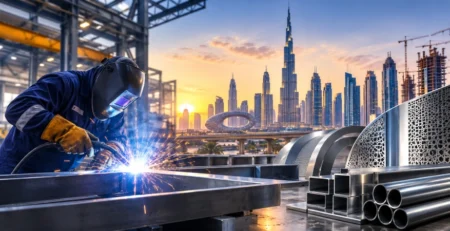
SHS offered by structural SHS suppliers is normally welded using either Gas Metal Arc Welding (GMAW/MIG) or Shielded Metal Arc Welding (SMAW/Stick). When it comes to structures, full-strength joints are normally the objective. It may require bevelling the ends of the sections to a thicker wall to ensure full weld penetration. Proper alignment is necessary to ensure that the load path is continuous through the centers of the sections.
5. Leverage Torsional and Multi-Axial Strength
The designer should always consider using the SHS in Dubai for structures exposed to torsional forces or multi-axis loading. Unlike I-beams that have high strength along one axis but are weak under twisting forces, the closed section provides equal strength in all directions. Therefore, it makes the sections suitable for unrestrained columns, trailer frames, and crane arms.
6. Adhere to Material Standards and Certifications
One should always ensure that the sections meet international standards such as BS EN 10210 (hot-finished) and BS EN 10219 (cold-formed). It ensures that the sections meet the structural engineering requirements at the most competitive SHS steel prices.
Don’ts to Keep in Mind When Handling Square Hollow Sections
After reading the dos, be sure to review the don’ts to avoid unnecessary complications during your construction project.
1. Avoid Leaving Sections Open to the Atmosphere
One should always avoid leaving the ends of a square hollow section exposed to the atmosphere. It is one of the main reasons for a structure’s premature failure. It significantly causes dirt to accumulate inside the sections, creating a corrosive environment that is inaccessible for inspection or repainting.
2. Avoid Improper Welding and Surface Preparation
However, one should never weld over mill scale, oil, or heavy rust, as this can result in a weakened weld, with porosity and inclusions introduced by these impurities. Moreover, ignoring the longitudinal weld seam of the square hollow section Dubai can be problematic, especially in high-load applications, where the weld seam should be kept away from the main tension area.
3. Avoid Excessive Heat Input and Distortion
As square hollow sections are relatively thin compared to solid sections, they are prone to heat distortion, especially during welding. Thus, over-welding can cause the square profile to become diamond-shaped, which can disrupt the entire structure. SHS in Dubai can be avoided by maintaining a balanced welding process and using small weld fillets where possible.
4. Avoid Unauthorized Alterations to Load-Bearing Members
Moreover, drilling holes or even cutting notches in the SHS manufactured by structural SHS suppliers after the structural design is complete can drastically reduce its load capacity. It is because the closed-loop design gives the SHS its strength. Cutting the loop by making notches on the corners and/or the faces can cause local buckling.
5. Avoid Mixing Incompatible Steel Grades
Using high-grade SHS in Dubai for the main structural components and low-grade steel for the bracing, or thick gusset plates, can lead to structural inconsistencies. Moreover, using different metal grades in components can cause galvanic corrosion, in which the more reactive metal corrodes more quickly.
6. Avoid Ignoring Local Buckling Limits
Even though galvanized SHS sizes come in different efficient designs, the flat face of the square shape can fold under pressure before the entire beam collapses. This phenomenon is called local buckling. Engineers should be aware that the width-to-thickness ratio of the chosen SHS is appropriate for the load capacity, thereby preventing sudden failure.
Summing Up!
With a wide range of applications, such as furniture (tables/chairs), building columns, agricultural fencing, trusses, machinery frames, trailers, and security grills, square hollow section is one of the most in-demand materials among engineers and contractors. Nevertheless, if you are searching for the most reliable manufacturer of an SHS in Dubai, look no further than Metal and Machine. We manufacture square hollow sections with end-to-end precision and advanced technology, integrating them across a wide range of applications. Contact us today to learn more about SHS or purchase it at the best price.
Frequently Asked Questions
No, it is not safe to drill holes in the SHS after installation. The strength of the SHS lies in the fact that it is a closed-section shape. When holes are drilled or notches are cut in the structure, the strength may be compromised. In this regard, it should be done only under the supervision of a structural engineer.
Yes, SHS in Dubai can be safely used for outdoor projects. However, certain precautions should be taken. When SHS is not painted or covered at the ends, moisture may enter the structure and cause corrosion from the inside. In this regard, galvanizing, painting, and capping the ends are very crucial.
As SHS is a closed-section shape, moisture may enter the structure from the outside. In this case, the moisture does not evaporate easily from the inside. It may cause silent corrosion. In this regard, the entire section should be painted from the inside, or proper drainage holes should be provided.
Welding over a dirty surface is a significant mistake that should be avoided. It weakens the weld. Another mistake to be avoided is applying excessive heat while welding. It may distort the shape.