Aluminium Fabrication- Know the Process and Importance in the Construction Sector
When it comes to aluminium, it is more than just a metal. It is the most sustainable, flexible, versatile, and user-friendly material that is used extensively in the construction industry. Furthermore, it fills the gap between strength and simplicity, offering contractors, property owners, engineers, builders, and professionals alike a comprehensive balance of aesthetics and functionality.
In the fabrication process, other metals may be rigid, bulky, and unwieldy to handle, aluminium is easy to handle. It can bend without breaking, be welded skillfully, and be finished to perfection. Aluminium is everywhere, from the ladder you use at home to the drinks you consume. Moreover, aluminium is versatile. It can comfortably fit into a weekend workshop or an aerospace laboratory. Furthermore, in this comprehensive blog, we will discuss the fundamental process and the importance aluminium fabrication in Dubai in the construction industry. Let’s get started!
What is Aluminium Fabrication?
Aluminium fabrication in Dubai is a wide process of cutting, bending, forming, and joining aluminium materials to form custom elements, structures, and finished products. Using fabrication, such as machining, welding, and extrusion, this entire process transforms raw aluminium into sustainable, corrosion-resistant, lightweight, flexible, versatile, and durable products for vast industries, such as construction, aerospace, and automotive.
Standard Technical Configuration of Aluminium in the Construction Industry
| Parameter | Standard Configuration / Specification |
|---|---|
| Alloy Series | 6000 series (e.g., 6061, 6063) |
| Temper | T5, T6 |
| Density | 2.7 g/cm³ |
| Tensile Strength | 150–300 MPa (varies by alloy & temper) |
| Yield Strength | 100–250 MPa |
| Corrosion Resistance | High |
| Thermal Conductivity | 160–200 W/m·K |
| Electrical Conductivity | 35–60% IACS |
| Surface Finish | Mill finish, anodized, powder-coated |
| Anodizing Thickness | 5–25 microns (typical) |
| Coating Thickness (Powder) | 60–120 microns |
| Fire Resistance | Non-combustible |
| Fabrication Methods | Extrusion, rolling, casting |
| Joining Methods | Welding, bolting, riveting |
| Thermal Expansion | 23 × 10⁻⁶ /°C |
| Recyclability | 100% recyclable |
| Applications | Windows, doors, curtain walls, cladding, roofing |
| Standards / Codes | ASTM B221, EN 573, IS 733 (India) |
| Typical Profile Thickness | 1.0 mm – 3.0 mm |
| Thermal Break Systems | Polyamide strips (PA66) |
Check out the Fabrication Process of Aluminium
Let’s discuss the end-to-end fabrication process of aluminium, if you are planning to use it in your next construction project:
1. Cutting and Preparation
The journey of the best aluminium fabrication in Dubai starts with cutting. Therefore, it involves separating the raw aluminium stock into particular shapes and sizes according to the industrial needs and specifications. When it comes to end-to-end fabrication, numerous high-precision techniques are employed depending on the required thickness and complexity. The technique of laser cutting is mainly applied where there are complicated patterns, which have high accuracy with less wastage. On the other hand, water jet cutting is regarded as the best approach to protect the integrity of the material because it does not involve heat but just high-pressure water jets to make a clean cut, and terefore it is unaffected by warping. Other commonly applied techniques include shearing and sawing for clean, straight lines. Likewise, cleaning is first done.
2. Forming and Bending
After the cutting process in aluminium fabrication in Dubai, the components are formed into 3D forms using the forming process. The most frequent of all these is bending, where the components are subjected to a press brake to bend the sheet metal into linear folds, taking into consideration material spring-back angles. Roll forming is used to build continuous, curved shapes or profiles. For more intricate, three-dimensional shapes, techniques such as stamping or deep drawing are employed to press the aluminium material into a desired shape and size. Furthermore, these fabrication techniques transform flat elements into functional parts, such as complex housings, brackets, or structural frames.
3. Machining or Drilling
Machining is crucial for creating high-precision features that cannot be achieved through bending or cutting, such as specialized slots, holes, or threads. Furthermore, Computer Numerical Control (CNC) machining, including milling and turning, is frequently used to ensure tight tolerances. Also, at this stage of aluminium fabrication Dubai, cutting tools are used to remove excess material, allowing the formation of intricately designed, smooth functional edges and fastening holes. Machining is often needed for secondary operations after the material has been extruded or cut into a rough shape.
4. Joining and Assembly
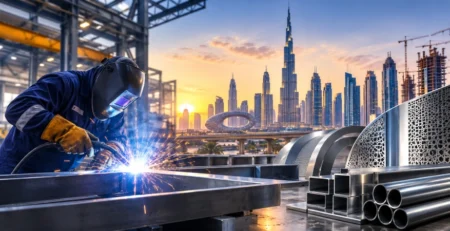
Once the individual elements are formed and machined, they are joined together through assembly methods. Welding is one of the primary joining methods, with TIG (Tungsten Inert Gas) welding used for high-quality, precise welds, and MIG (Metal Inert Gas) welding suited for thicker elements. Aluminium welding needs high and advanced skills to handle heat control and prevent distortion. Alternative non-welding methods in the best aluminium fabrication in Dubai include bolting, fixing, and industrial bonding. Additionally, the fastening methods are common when creating extensive structural assemblies or when the raw materials of aluminium fabrication are too thin for conventional welding.
5. Finishing and Surface Treatment
Now, we are at the last step involved in the manufacturing of aluminium, which includes finishing. This step improves not only the appearance but also the material’s ability to protect against various factors. In addition, anodic oxidation is a widely used electrochemical method for increasing the oxide layer thickness, thereby improving corrosion resistance and hardness. Moreover, other finishing methods such as powder coating are also very popular due to their sustainability, color and protection of the surface from fading, scratching, and chipping. Another approach in this aluminium fabrication Dubai is polishing, buffing, or grinding to achieve excellent surface smoothness.
Significance of Aluminium Fabrication in the Construction Industry
Below are the main reasons why aluminium fabrication in Dubai plays such a significant role in the construction industry:
- As an aluminium material, it is only one-third the weight of steel. Thus, it reduces structural loads and installation costs, making it an ideal choice for tall buildings and complex structures.
- When it comes to corrosion resistance & durability in aluminium, the natural oxide layer safeguards it from environmental damage (rust) without extra layering or coatings, ensuring durability and sustainability in populated or coastal environments.
- Aluminium fabrication can be extruded into complex, customized shapes and powder-coated or anodized in numerous finishes, allowing for contemporary, sleek architectural designs.
- It has high thermal conductivity, which allows for thermal development of broken window frames and facades, enhancing building insulation.
- When it comes to installation and fabrication, being malleable enables off-site prefabrication, significantly reducing on-site construction time and labor costs.
Wrapping It Up!
Aluminium fabrication remains a significant process in manufacturing, supporting numerous industries by transforming raw materials into finished products and parts. If you are also looking for the leading manufacturers for aluminium fabrication in Dubai, look no further than Metal and Machine. With high-end technology, we offer a wide range of fabricated aluminium in your desired shapes and sizes. So, connect with us today and get your desired aluminium products for your construction projects.
Frequently Asked Questions
Let’s find out the primary distinction between aluminium and steel construction:
- The first benefit of aluminium construction is the low weight compared to steel.
- Aluminium doesn’t corrode.
- Steel is more durable and stronger compared to aluminium.
- The maintenance of aluminium constructions is lower than that of steel.
- While aluminium construction is more expensive at first glance, taking into account all costs, it turns out to be cheaper.
In aluminium construction, 6000-series alloys, such as 6061 and 6063, are most commonly used. Moreover, T5 and T6 tempers are applied when manufacturing aluminium constructions to modify the hardness and strength of alloys.
Aluminium construction has numerous benefits that make it perfect for building structures. Let’s see what they are:
- It is lightweight, reducing the load of the structure.
- It has high resistance to corrosion, extending its life span.
- It is flexible enough to build any constructions and shapes.
- High thermal conductivity makes it easier to construct the insulation system.
- Faster assembly helps save both time and money.
Yes, it definitely is. Aluminium fabrication is the most environmentally friendly solution. It is possible to recycle aluminium completely, maintaining the same quality level of the material.